

12 November 2025

Matthew Bezuidenhout,
Electrical Control, Monitoring,
Installations Manager, Master Power Technologies
Remote monitoring and analytics are critical for improving efficiency, ensuring uptime, and maximising return on investment. The African data centre landscape differs from Europe in several ways particularly in terms of the availability of skilled on-site personnel, access to spare parts, and general infrastructure reliability.
In the early days of the telecom boom, Africa’s rack densities and power demands were relatively low, so outages were more tolerable. But as the continent has rapidly advanced, the technology has evolved faster than the local skill base and parts supply chains.
That’s where remote monitoring becomes vital. It enables real-time visibility into systems across multiple countries, helping teams diagnose issues, prevent faults, and assist local staff more effectively even where there are language or technical barriers.
In regions where power grids are unstable, equipment experiences accelerated wear and tear and what would take nine years in Europe can happen in a week in a bad power area. Remote monitoring allows operators to stay a step ahead, predicting failures and maintaining uptime despite these challenging conditions.
A good example comes from South Africa during load shedding. One major hosting facility faced what we call a “Utility Generator Cyclical Transition,” the constant switching between grid and generator power due to unstable utility supply. Each switch puts strain on transformers, and through our monitoring, we detected that one transformer tap had burned out.
Because of experience with these phenomena in the past, our proprietary changeover algorithms prevented the site from experiencing any downtime where any other industry changeover system would have dropped the facility, and, in tandem with the real-time remote monitoring services, we were able to diagnose the issue immediately and resolve it within the hour.
Another case involved battery monitoring. Many operators stretch their battery life due to budget constraints even though batteries rated for 10–15 years in ideal conditions often last only 7-9 years in Africa. Through our remote system, we identified batteries nearing end of life and prevented a total site failure.
Similarly, real-time environmental monitoring allows us to detect and mitigate cooling failures immediately. Instant alerts mean faster response times, which have saved major facilities multiple times from outages.
We’ve completed large-scale installations across Nigeria, Mozambique, Lesotho, South Africa, Congo, and Zambia, and the main challenges are rarely technical as they’re usually about on-site housekeeping, skill levels, and training.
After installation, you can’t just walk away. Local teams need to understand what the alarms mean and how to respond. It’s like a car dashboard when the warning lights are only useful if the driver knows what they indicate.
So, the real challenge lies in transferring knowledge and ensuring operational understanding. That’s why remote monitoring isn’t just about gathering data: it’s about creating transparency and accountability. Global auditability lets us and the customer track system performance objectively.
Other challenges include logistical issues like security, travel restrictions, and safe access to sites. And a specific technical hurdle is network connectivity: many projects are delayed because IT teams struggle to set up secure VPN links to enable remote access. Even when hardware and software are ready, connectivity often becomes the bottleneck.
Moreover, security and data integrity are also growing priorities. Many African facilities are still developing strong ICT and cybersecurity frameworks, so ongoing support and training are key to long-term success.
The strength of AIVA lies in its open and flexible architecture. It allows data accessibility (securely, of course) and seamless integration with other systems.
Most data centres are built for redundancy - two generators, two UPS systems, dual cooling units - yet many still rely on a single building management system (BMS). If that fails, you’re essentially blind.
AIVA’s open-source, vendor-agnostic approach means our system can act as redundancy for others, or vice versa. Customers can experiment with different vendors without being locked into one expensive, proprietary ecosystem.
Structured licensing from traditional vendors often becomes costly over time, especially when systems reach end-of-life. By contrast, AIVA provides flexibility and long-term cost efficiency.
The open architecture also makes integration with AI and machine learning easy. Some of our clients now extract historical data directly from AIVA to train predictive models which is something we can enable simply by providing secure API access.
Finally, because we can integrate with both legacy and modern systems, customers can enhance visibility without overhauling entire facilities, which is a major cost advantage in Africa.
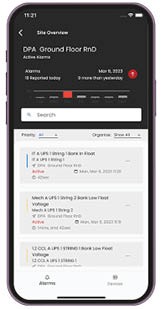
Multi-site consolidation gives data centre managers complete transparency across all their facilities through a single platform, even directly on a mobile app. That’s essential in Africa, where managers aren’t always at a desk or connected via VPN.
The system helps create accountability. Once senior management can see site-level alarms and maintenance issues in real time, local teams are motivated to act faster. It naturally improves operational habits and resilience.
It also allows direct comparison between sites: analysing performance, efficiency, and cost structures to build stronger business cases. Managers can see which facilities perform best under certain conditions or which equipment is most efficient. AIVA also integrates peak-time tariffs and energy use data, helping managers determine the most cost-effective times to run high loads.
During COVID-19, this visibility proved invaluable. We deployed AIVA for major carriers in Nigeria and South Africa, allowing them to operate efficiently when site access was restricted. In Madagascar, during recent unrest, remote access again ensured teams could manage sites safely without being physically present.

Most data centres have on-site teams, but remote monitoring brings essential oversight and coordination, especially across shifts and multiple facilities.
The key to an effective monitoring and analytics strategy is precision, depth, and real-time responsiveness. It’s not enough to receive a generic “aircon fault” alarm; you need granular insight into whether it’s a dirty filter or an impending system failure.
Some vendors charge per monitoring point, which quickly becomes expensive in Africa. Instead, operators need deep, high-resolution monitoring that provides actionable data without excessive licensing costs.
Equally important is the partnership behind the system. You need a skilled vendor who can interpret the data and translate it into meaningful insights. There’s no value in a system that only tells you “an alarm is active” without explaining what it means or how to respond.
Finally, because grid fluctuations in Africa happen in milliseconds, not minutes, the system must provide real-time data at high resolution to detect problems early.
So, the “ultimate answer” is a combination of real-time depth, intelligent analysis, and a capable partner with remote visibility at the heart of it all.